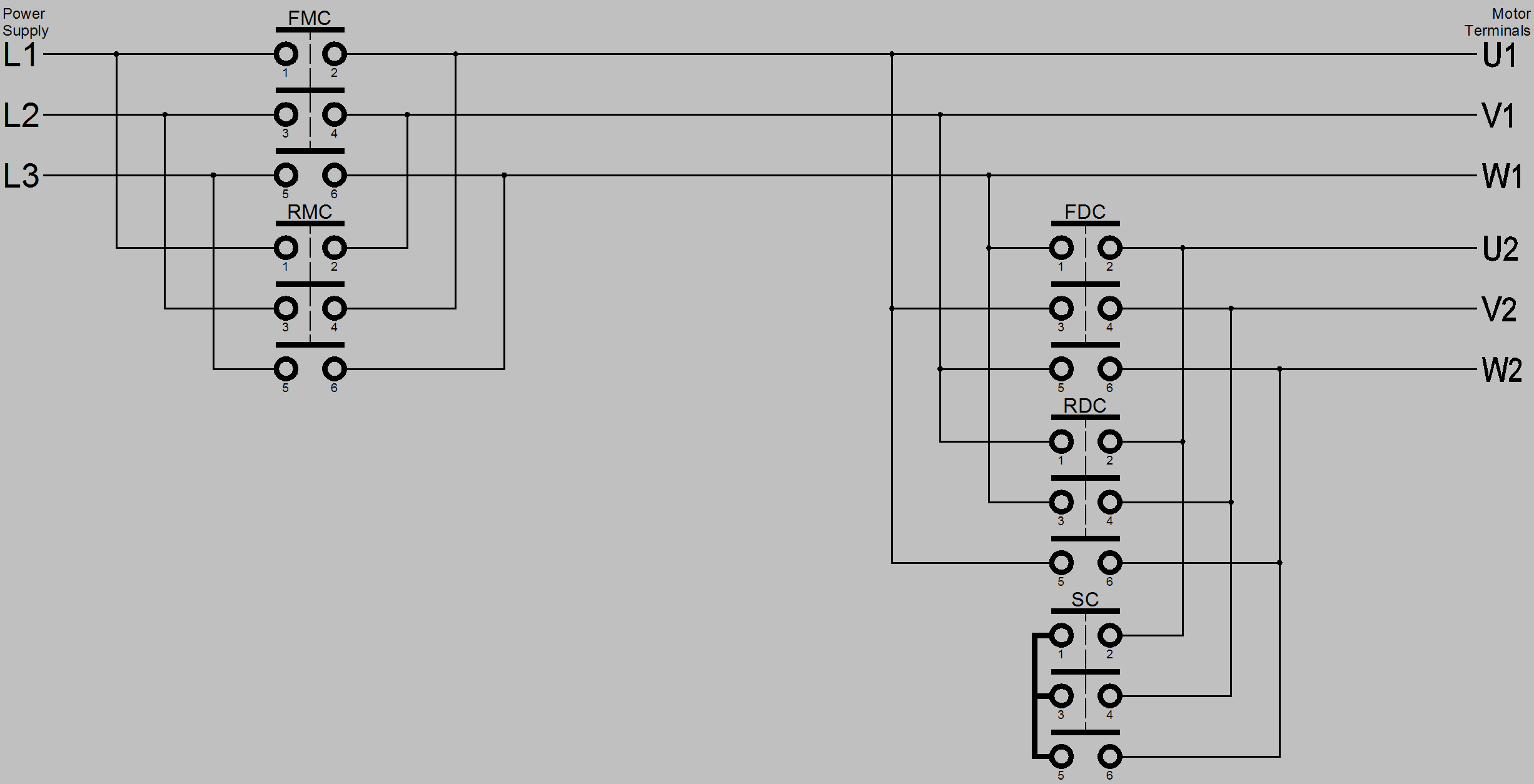
Power Circuit
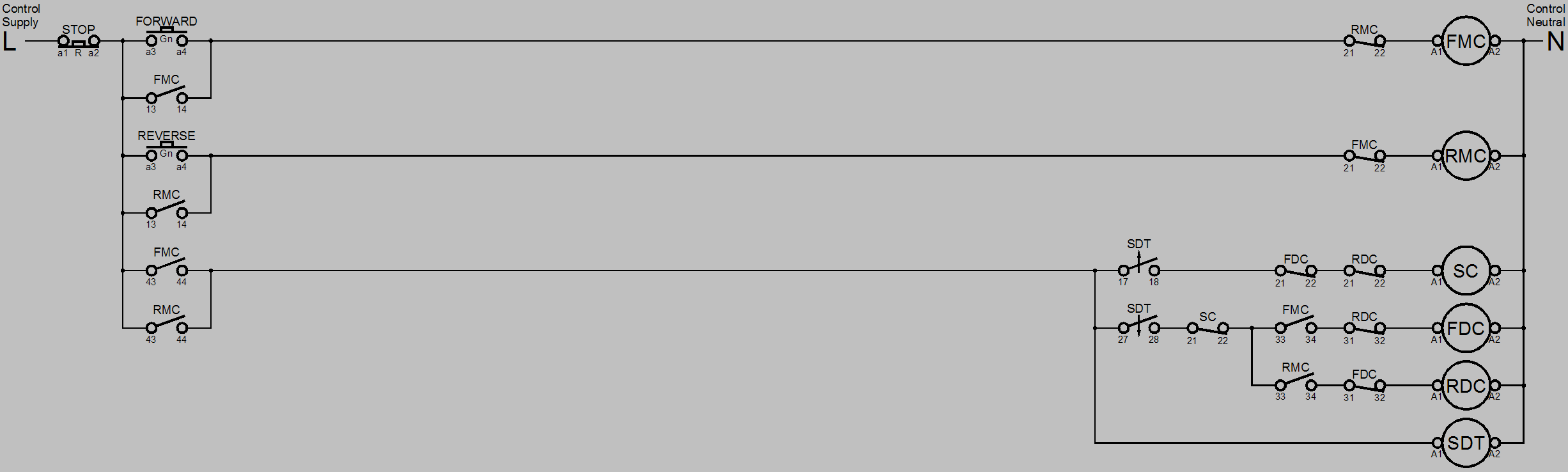
Control Circuit
Circuit Operation
The contact on terminals a3-a4 of each start push button energises the required direction contactor, either the forward main contactor FMC or the reverse main contactor RMC, the relevant main contacts 1-2, 3-4 and 5-6 close which puts power; with either clockwise or anticlockwise phase rotation; to the motor terminals, normally open auxiliary contacts of the relevant direction contactor on terminals 13-14 close to maintain the power to that direction contactor when the button is released.
When either the forward or reverse button is pressed it’s contacts a3-a4 close, the relevant main contactor coil FMC or RMC is energised which causes it’s main contacts on terminals 1-2, 3-4 and 5-6, the normally open auxiliary contacts on terminals 13-14, 23-24 and 33-34 to close and normally closed auxiliary contact on terminals 21-22 to open. The auxiliary contact on terminals 13-14 maintains power to it’s contactor coil when the forward or reverse button is released. Power is connected from the power supply to the motor terminals U1, V1 and W1. At the same time the main contactors second normally open contact on terminals 43-44 closes and the star delta timer SDT energises which causes its instantaneous close, delay to open contact on terminals 17-18 to close, this in turn energises the star contactor SC which causes its main contacts on terminals 1-2, 3-4 and 5-6 to close and its auxiliary contact on terminals 11-12 to open. Motor terminals U2, V2 and W2 are connected together thus completing the motor circuit. The motor starts with a reduced voltage on each winding and accelerates in the selected direction to a speed that is load dependant. The voltage reduction is √3 of the line voltage. The star delta timer SDT is a special type of time delay relay that has two contacts. After a preset time the star delta timer SDT instantaneous close delay to open contact on terminals 17-18 opens which de-energises the star contactor coil SC which causes its main contacts on terminals 1-2, 3-4 and 5-6 to open and it’s normally closed auxiliary contact on terminals 11-12 to close. The motor circuit becomes open circuit. The star delta timer SDT delay to close contact on terminals 27-28 closes 50-60milli-seconds after the preset time which opened the contact on terminals 17-18. The additional delay is to allow the star contactor to open and its disconnecting arc to extinguish, it also allows the reset of any mechanical interlock between the star and delta contactors before the relevant delta contactor either FDC or RDC coil is energised. Star delta timer SDT delay to close contact on terminals 27-28 closing energises the relevant delta contactor either FDC or RDC which causes its main contacts 1-2, 3-4 and 5-6 to close, its auxiliary contact on terminals 11-12 to open and auxiliary contacts 21-22 and 31-32 to open. The power supply is connected to motor terminals U2, V2 and W2. Thus each winding has the full voltage applied to it, the motor accelerates to full speed in the selected direction.
To stop the motor the stop button is pressed its contacts a1-a2 open which de-energises the energised contactors and timers thus stopping the motor by removing its power supply and resetting the control circuits.
The auxiliary normally closed contacts on terminals 21-22 of the forward FMC and reverse RMC contactors are placed into each others coil circuit so that electrically the two contactors cannot be simultaneously energised which would cause a short circuit, this can be seen by examination of the above circuit. It is normal to mechanically interlock the forward and reverse contactors in addition to the electrical interlock. It can also be seen from the above circuit that it is not possible to change the direction without first pressing the stop button to de-energise the energised contactor.
The auxiliary normally closed contacts on terminals 21-22 and 31-32 of the star SC and both delta contactors are placed into each others coil circuit so that electrically only one of the three contactors can be energised at one time, should any two or more close simultaneously a short circuit would result, this can be seen by examination of the above circuit. It is not possible with most contactors to mechanically interlock with two other contactors where this is possible the three contactors should be mechanically interlocked.